Half the towns we print have fewer than a thousand people
We went and counted.
Our catalog has 19,494 towns with a population on file. Of those, 9,285 have fewer than a thousand people. That's not a rounding error, that's basically half. Go further down and 6,154 are under five hundred. A full 1,098 towns have fewer than a hundred residents.
Towns over a hundred thousand people? There are 273 of them. That's one and a half percent of the list.
The middle of our catalog, the exact median town, has about 1,114 people in it. That is what typical looks like in America once you stop counting by population and start counting by town.
Iowa is the small-town capital
Sorted by how many sub-thousand towns each state has, the top of the list goes: Iowa 676, Illinois 627, Missouri 610, Minnesota 507, Kansas 428, Texas 424, Nebraska 423, Pennsylvania 410.
Iowa beating Texas is the kind of fact that reorganizes how you picture the country. Texas is enormous and has more people. Iowa just has more towns, because it was settled on a grid of farm communities spaced about as far apart as a team of horses could comfortably haul grain in a day. Those spacings are still there. The horses aren't.
The smallest one has a mayor, a librarian, and a bartender
At the very bottom of our list, a handful of towns are down in the single digits. Our file has New Amsterdam, Indiana at 1. Goss, Missouri at 1. Hoot Owl, Oklahoma at 1. Lost Springs, Wyoming at 1. Luckenbach, Texas at 3, which you already know from the song.
And Monowi, Nebraska, at 2.
Monowi is the famous one, and our number is out of date in a way that's worth explaining. Monowi had about 150 people in the 1930s, back when it was a railroad town with a real main street. By the 2000 census it was down to two: Elsie Eiler and her husband Rudy. Rudy died in 2004.
So it's been one for twenty years. Elsie is the entire town. She is the mayor, the clerk, the treasurer, and the librarian, and she runs the Monowi Tavern, where she has been serving burgers and cold beer to people who drove a long way to see a town with one resident.
Here's the detail that gets us, though. When the 2020 census came back, it reported Monowi's population as two. Elsie, who is the only person who lives there and would presumably have noticed a neighbor, found out from a reporter that she had apparently doubled.
Which is the whole problem with the number
We wrote a while back about how the population is coming off city limit signs, and how the number on those signs was always a little bit fictional. Monowi is that story in its purest form. The official count says two. The actual count is one. The woman in question is standing right there.
Our own figures are no better, and we've been upfront about that. The database behind this site was loaded in July 2011 off Census estimates from a few years earlier. Every number on this page is a photograph of a moment that has already passed. Some of these towns have grown. More of them have shrunk. A few aren't there at all anymore.
That's sort of the point
You could read nine thousand towns under a thousand people as a story about decline, and plenty of people have written that version.
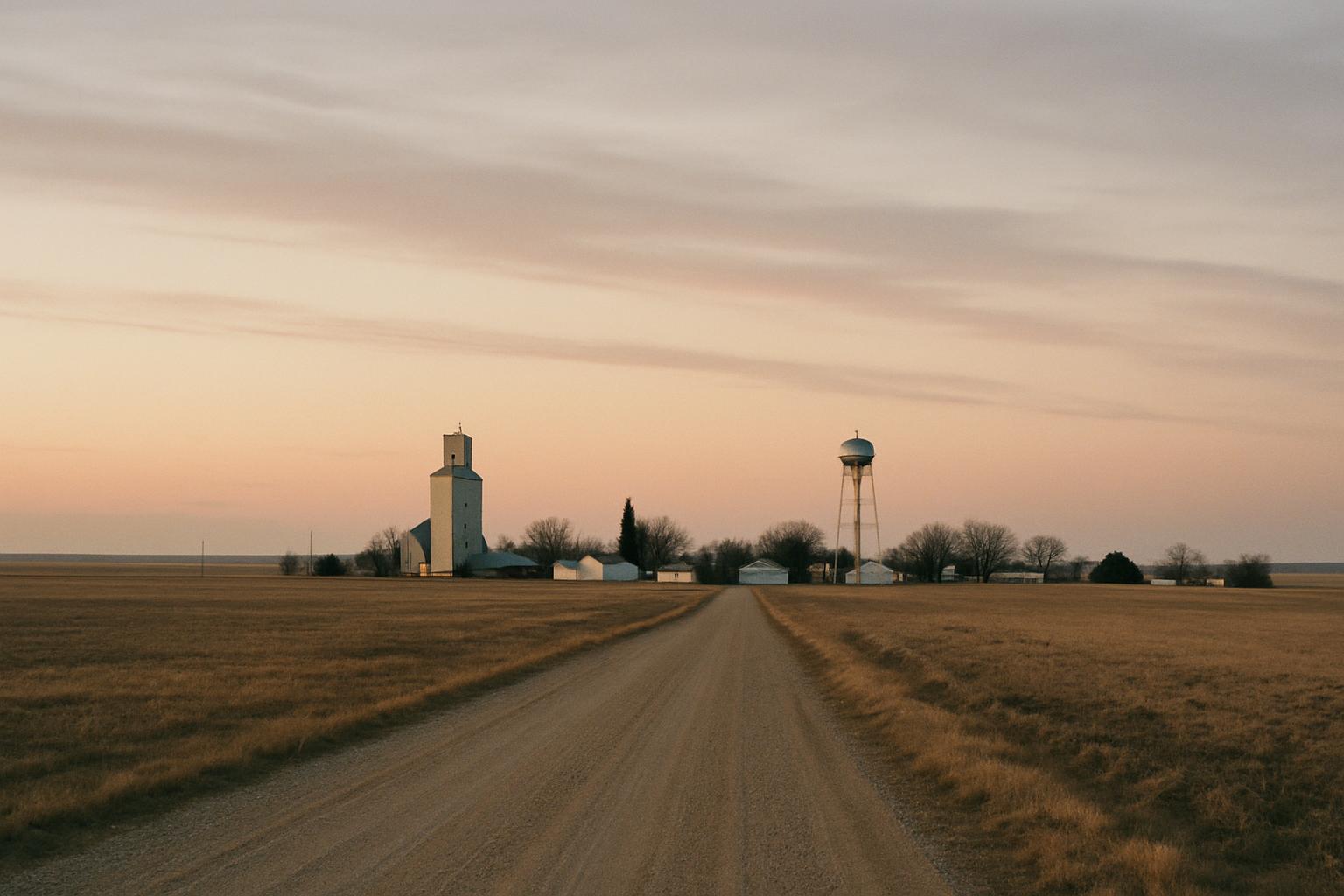
Here's the other reading. Nine thousand times, somebody drew a boundary around a cluster of houses and a grain elevator and a church and said this is a place, it has a name, and the name goes on a sign. Nearly all of those places are still there. They are smaller than they were and the young people mostly left, and the sign is still standing at the edge of town with a number on it that stopped being true a while ago.
The number was never the part that mattered. Ask anybody from a town of four hundred what the sign says and they'll tell you the number without thinking. Then they'll tell you it's wrong. Then they'll tell you a story about the water tower.